Jardim da Parada
At the centre of Campo de Ourique, Jardim da Parada is less a detour than a shared neighbourhood room: shade, benches, coffee, children playing, people talking, and the bairro moving through it.

The garden at the centre of Campo de Ourique
Jardim da Parada is the name most people use, but the garden's official name is Jardim Teófilo Braga. It occupies a full block in the heart of Campo de Ourique, bordered by everyday streets rather than monuments, which is part of why it feels so embedded in local life.
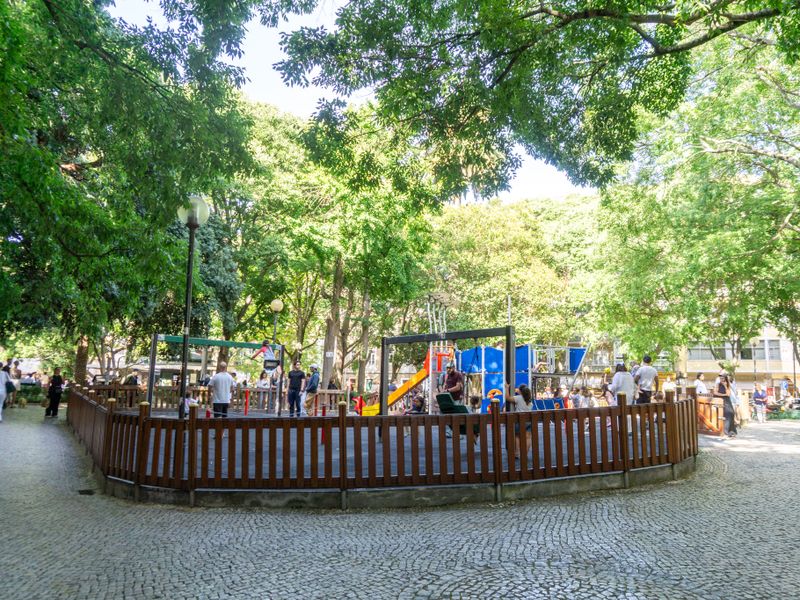
The scale is modest: roughly 0.4 hectares. That compactness matters. You can cross it quickly, but the garden is built for lingering, with shade, benches, a pond, a playground, a cafe terrace, and paths that keep pulling people back into the middle.
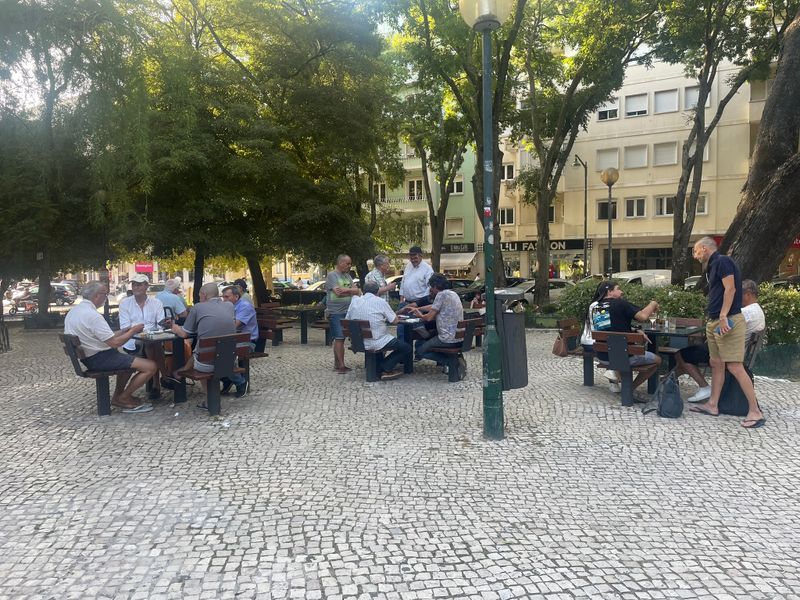
The cafe terrace is part of the rhythm. Hamburgueria da Parada operates from the garden kiosk, with outdoor tables for coffee, drinks, and casual meals. Its position close to the playground makes it especially practical for parents who want to sit nearby while children play. Other tables around the garden often fill with regulars playing card games, so the social life of the square is not only at the kiosk.
On some Saturdays the garden also becomes a small open-air market. The Mostra de Artesanato de Campo de Ourique is commonly listed for the third Saturday of each month, from 08:00 to 18:00, with stalls for crafts, regional products, and local sellers. Treat the timing as a useful guide rather than a guarantee, since outdoor markets can change with weather, holidays, or local programming.
Why it is called Parada
The familiar name comes from the site's earlier role as a military parade ground connected with the Campo de Ourique barracks. The official name honours Teófilo Braga, the writer, professor, and second President of the Portuguese Republic.
That layered identity suits the place. It is formal enough to hold a statue and a bandstand, but informal enough to work as a daily meeting point for residents, families, and people stopping between errands.
Maria da Fonte, the pond, and the trees
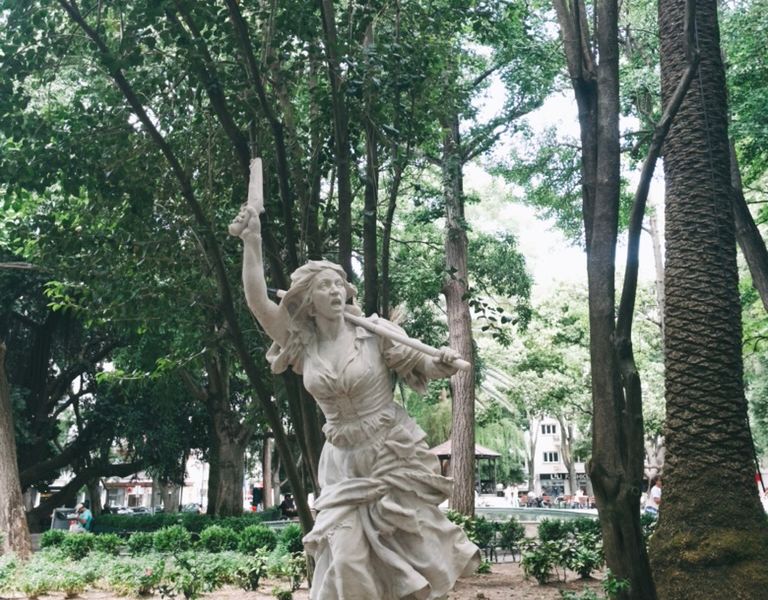
One of the garden's clearest historical markers is the statue of Maria da Fonte, installed in 1920 and made by sculptor Costa Mota. It commemorates the popular revolt associated with Maria da Fonte, giving the garden a civic note among its quieter routines.
The pond gives the garden another focal point, especially in warm weather when people sit around its edge. The wider planting is also part of the garden's character: Lisbon's municipal information notes four classified trees here, including two metrosideros, a sequoia, and a bald cypress.
How to experience it
Come for a coffee, sit by the pond, or use it as a soft midpoint in a walk through Campo de Ourique. The Mercado de Campo de Ourique, the neighbourhood's small shops, and the surrounding residential streets are all close enough that the garden naturally becomes part of a slower route rather than a single stop.
The best way to read Jardim da Parada is not as a scenic attraction set apart from the neighbourhood, but as one of the places where Campo de Ourique shows its everyday shape.
Tables, conversation, and card games
The tables beside the garden are often busy with groups talking and playing card games, one of the familiar daily scenes around Parada.
Credit: campodeourique.com